
Customer service at a farmers market is not a support ticket. It is a person standing in front of my table with a question, a line behind them, and about fifteen seconds before they decide to buy or walk. I have watched a good answer turn into a sale and a slow answer turn into a shrug. That is why I spent three market days testing three different customer service workflows for Prompt & Pepper, and why the results surprised me.
This is the fourteenth entry in The AI Test Log and the fourth in the Small Money column. When people talk about AI for small business customer service, they usually mean chatbots and help desks. At my scale, it means preparing my own answers, handling complaints without sounding like a script, and knowing when to put the tool down. If you run a one-person operation, this is the version of the question that actually matters.
The Problem: Ten Questions, Fifteen Seconds Each
What Customers Actually Ask
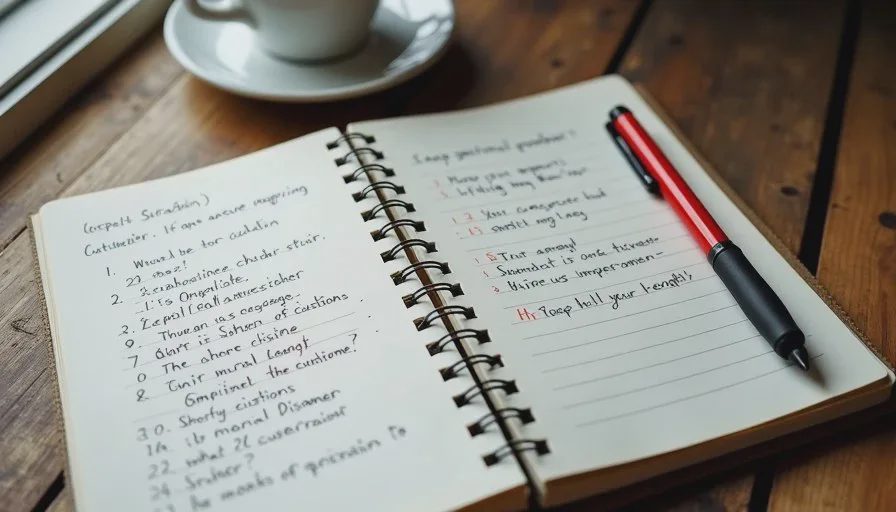
I logged every question at my booth across three markets. The list is short and it repeats. How hot is it? Is it sweet? What do you put it on? How long does it keep? Do you ship? Is it gluten free? Do you have a milder one? Can I sample it? Do you take cards? Are you here every week?
Ten questions. About eighty percent of everything asked. The other twenty percent is small talk, which I enjoy and which no system needs to handle.
Why This Is a Customer Service Problem
The temptation is to treat these as product questions. They are not. They are trust questions. A customer who asks how hot the sauce is wants to know whether they can trust me not to ruin their dinner. The answer matters less than how quickly and clearly I give it.
What I Was Actually Testing
Three workflows, tested one per market. The first was a written prep sheet I created before the market and did not read during it. The second was a printed card on the table that customers could read themselves. The third was a live assistant on my phone that I could check mid-conversation.
I want to be clear about the third one. I did not use it to answer customers. I used it once, to look up a question I did not know the answer to, and I will describe what happened.
Workflow One: The Written Prep Sheet
What I Did
The Friday before the first market, I typed the ten questions into an assistant and asked for short answers under twenty words each, in plain language, no health claims, no numbers I had not given it. Then I rewrote every answer on paper in my own words, crossed out three, and condensed the rest.
That is the important part. I did not use the model's answers. I used the model's structure. Writing my own answers forced me to decide what I actually say, which I had never done before.
What Happened at the Market
I did not read the sheet during the market. I did not need to. Having written the answers once, I said them the same way all day. Customers got consistent answers, and I got faster at answering because I was not composing from scratch each time.
Two questions surprised me. The gluten-free question came up more than I expected, and I was glad I had written a clear, accurate answer instead of improvising. The shipping question came up and I had a short answer ready, which felt better than my old habit of explaining my whole online order process to someone who had already stopped listening.
The Result
This was the winner by a wide margin. It cost me about forty minutes on a Friday evening and it changed the entire day. AI's contribution was structure and a first pass, and my contribution was every word that mattered.
Workflow Two: The Printed Customer Card
What I Did
For the second market, I printed a small card with five frequently asked questions and short answers, placed it on the table facing customers.
What Happened
About one in five customers read it. The rest asked anyway. Of the ones who read it, a few asked a follow-up that showed they had understood, which was a good sign.
It did not save me time. It did add something I did not expect, which was that shy customers used it instead of asking. Two people pointed at the heat-level line rather than asking me directly, and both bought a bottle.
The Result
Useful, not essential. I kept the card, but I would not build a market day around it.
Workflow Three: The Live Assistant
What I Did
For the third market, I kept an assistant on my phone in my apron pocket. The plan was to check it only if a customer asked something I genuinely did not know.
What Happened
One person asked about a specific dietary restriction I had not prepared for. I said I would check, stepped to the side, and typed the question into the assistant. It gave me a confident answer that included a claim about an ingredient interaction. I did not repeat it. I told the customer I would follow up, wrote down their question, and answered them honestly the next day after checking my own records.
That took longer than the other two workflows and it produced nothing I could use in the moment.
Why Two Workflows Worked and One Did Not
The Prep Sheet Worked Because It Was Mine
The model gave me structure. The words came from me and from my own records. When I said them at the table, they sounded like me because they were mine.
The Card Worked Because It Was Static
Customers could read it without me, at their own pace, and it helped the people who did not want to talk. Low risk, low cost, modest gain.
The Live Assistant Failed Because of the Setting
A market table is a bad place to check a chatbot. There is a line, there is no time, and the stakes are real. A confident wrong answer about a dietary restriction is not a small error. It is the kind of mistake that ends a customer relationship.
The lesson is not that the tool is bad. It is that the setting makes verification impossible, and anything I cannot verify in fifteen seconds has no place in a live customer conversation.
What AI Does and Does Not Do Here
It does not answer customer questions. I do that.
It does not know my ingredients, my shelf life, my heat levels, or my shipping process. Those come from my own records and they always will.
It does not handle complaints. I have had two in two years and both were resolved with a conversation and a refund. Tone is the entire job in a complaint, and tone is the thing AI drifts on hardest.
It does help me prepare. It structures the question list, it drafts short answers I then rewrite, and it helps me notice which questions keep coming up. That last part has value I did not expect. Seeing the same question twelve times in a log made me change my sign, which reduced the question to four times the following week.
Pitfalls I Hit
Trusting a Dietary Claim
Covered above. The assistant produced a specific claim about an ingredient interaction with no source and no way for me to check it at the table. That is the failure mode I have now seen in every column of this log, and it is the one that carries real risk.
Answering Too Long
My first prep sheet answers were forty words each. The rewritten versions were under twenty. At a market table, twenty words is already long. The model writes for reading. A market requires writing for speaking.
Forgetting the Follow-Up
The customer with the dietary question expected an answer the next day. If I had not written it down, I would have lost that trust. The prep sheet did not cover it, and I now keep a small notepad for exactly this.
What Still Needed Human Judgment
Every answer about ingredients, allergens, shelf life, and heat. Every complaint. Every decision about when to stop talking and let a customer taste the sauce, which is a read of the person in front of me that no system shares.
I also keep the final call on what goes on the customer card. The card is a claim in writing, and a claim in writing has to be something I can stand behind.
Cost and Time
AI cost: nothing beyond my existing subscription. Prep sheet: about forty minutes on a Friday. Customer card: about thirty minutes to write and ten to print. Live assistant: about five minutes of market time and one follow-up conversation the next day. Net gain across the season: the prep sheet alone, plus a sign change that cut repeat questions by roughly two-thirds.
Final Verdict
Useful with guardrails.
For preparing answers before the day, this was worth every minute. For anything live at the table, it stayed out of the way, and that is the right call. Customer service at a small market is a human job with a preparation problem attached. AI helps with the preparation. It does not get to be the voice.
Take it apart first. Then ask AI.


No comments yet — be the first to share a thought.