
I have written a lot of sauce labels at midnight, and I have written a lot of market signs in parking lots with a dying marker. Both jobs are small, repetitive, and easy to put off until the last possible minute, which is exactly the kind of work AI for product descriptions should help with. It does help, and it also fails in specific ways that have cost me a batch of labels and one very bad sign.
This is the twelfth entry in The AI Test Log and the second in the Small Money column. Prompt & Pepper is my barbecue sauce business, six flavors on a good week, sold at Colorado farmers markets. Everything below is from my own kitchen table, my own printer, and my own mistakes. If you are looking for a clean demo, this is not it. If you want to know which parts of the writing work are worth delegating, keep reading.
Why Label Copy Is Harder Than It Looks
The Space Constraint
A sauce label has room for about thirty-five words of description, and half of that gets eaten by required elements like ingredients, weight, and contact information. What is left has to do three jobs: tell a customer what the sauce tastes like, tell them how hot it is, and give them a reason to pick up the bottle instead of the one next to it.
That is a lot of work for two sentences.
The Voice Problem
My customers are home cooks at a farmers market. They ask whether a sauce is sweet or hot before they ask anything else. They do not want restaurant-menu language. They do not want adjectives stacked three deep. They want plain words that match what they will taste.
Every generic product description I have read online fails this test. It is written for a search engine, not for a person holding a jar.
Where AI Fits
AI is good at producing options quickly and at cutting a paragraph down to thirty-five words. It is bad at knowing what my customers ask, and it has no idea what my sauce actually tastes like. So I use it for the first half and I do the second half myself.
The Label Process I Use Now
Step One: Write the Truth First, by Hand
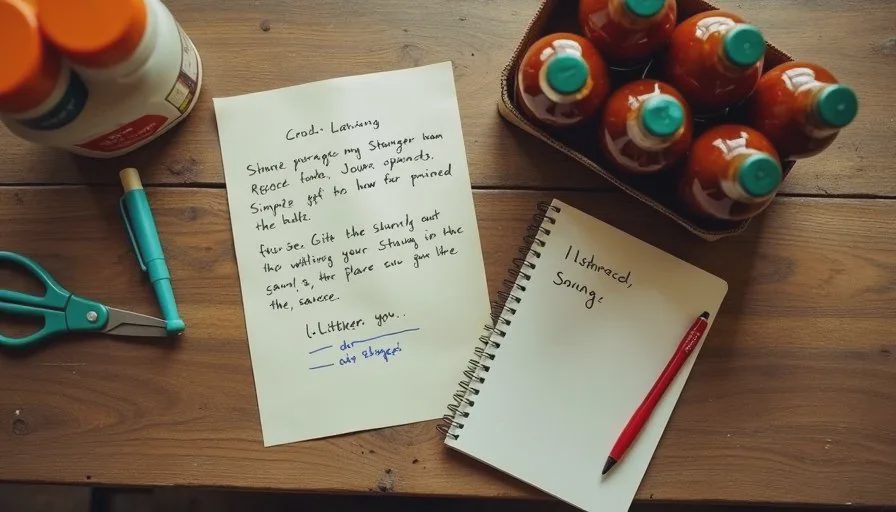
Before I open anything, I write three facts about the flavor on a piece of paper. For the green chile sauce, that was: roasted Hatch chiles, medium heat, tangy finish. That is it. Three facts.
This step matters because it gives the model something specific to work from. Without it, I get adjectives. With it, I get sentences that are actually about my product.
Step Two: Ask for Three Versions, Not One
I paste the three facts and ask for three label descriptions under thirty-five words, plain language, no restaurant words, no health claims.
Three versions instead of one does two things. It gives me choices, and it shows me the range of what the model thinks is possible. Usually one version is too dry, one is too salesy, and one is workable with edits.
Step Three: Rewrite in My Own Voice
I take the workable version and rewrite it on paper. Then I type it into the label template. On a typical flavor, I change about half the words.
That sounds like a lot of editing. It is still faster than starting from a blank page, and the result sounds like me, which is the only thing that matters at the table.
Step Four: Read It Out Loud
This is the step I added after a batch of labels went out with a phrase I would never say. If I stumble over a sentence when I read it aloud, it does not go on the bottle. That single check has saved me more embarrassment than any other habit.
Product Descriptions for Online Orders
The Difference From Label Copy
Online, I have more room. A product description can run a hundred words and include storage instructions, pairing suggestions, and shipping details. That is a different job than a label, and I treat it that way.
What I Ask For
I paste the three facts, the label copy I already wrote, and one example of a description I liked from a previous season. Then I ask for a hundred-word description with three short paragraphs: what it tastes like, how to use it, and how to store it.
The example matters more here than anywhere else. Without it, the tone drifts toward a catalog. With it, the output stays close to how I actually talk to customers.
What I Always Rewrite
Storage and shipping details. Every time. Those have to match my actual process and my actual shelf-life guidance, and a model has no way to know either. I write those paragraphs myself, from my own records.
I also rewrite anything about heat level, because heat is subjective and my medium is someone else's hot.
Market Signs, Where AI Has Failed Me Twice
The First Failure
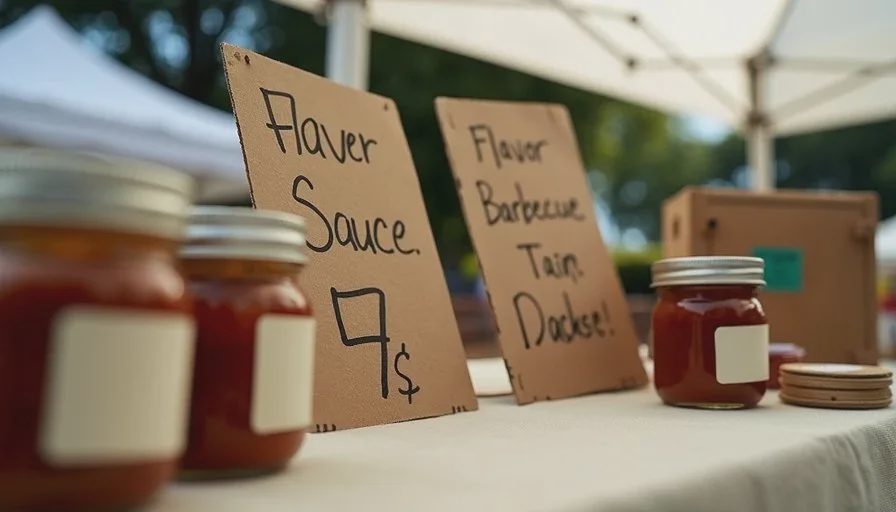
I asked for a price sign layout with three tiers, clear headers, and tidy columns. It looked organized on my laptop. At the market, the header was too small, the flavor names sat below the prices, and two customers asked me to explain the sign instead of reading it.
I flipped it over at 9:15 and hand-wrote a simpler version. Flavor on the left, price on the right, big numbers, nothing else.
The Second Failure
A year later I tried again, this time asking for a sign that would read from six feet away in morning glare. The output was better and still not right. The font suggestions were too light for outdoor light, and the layout assumed a flat wall instead of a table with bottles in front of it.
What I Do Instead
Now I use AI for the words on the sign and I design the layout myself. I test every sign by taping it to the table, walking six feet back, and reading it in the same light I will sell in. That test takes two minutes and has caught every problem before it reached a customer.
Words are a writing task. Layout is a physical task. Treating them as the same job is the mistake I made twice.
What AI Does Not Do in This Work
It does not know what my sauce tastes like. It does not know what my customers ask. It does not know the state labeling requirements for cottage food operations, and I do not ask. It does not know my shelf life, my shipping process, or my cost per jar.
Anything in those categories comes from my own records or from the state guidance page. I write it myself, and I check it twice.
The Numbers From My Own Kitchen
Label writing used to take me about two hours for a full set of six flavors, including printing and trimming. With this process, it takes about seventy minutes. Product descriptions for online orders used to take forty minutes each. Now they take about fifteen, including my rewrites.
The sign is the exception. AI saves me nothing on signs, because the failure rate is high enough that I skip straight to handwriting. That is a real result and it belongs in the log.
Pitfalls I Hit So You Do Not Have To
Feeding It No Customer Context
My first label drafts sounded like a restaurant menu. The fix was telling the model who my customers are and what they ask. That single sentence changed the output more than any prompt technique.
Trusting a Number It Invented
I once got a suggested shelf life in a draft description. I did not catch it until the second read. It was plausible and it was not mine. Anything numeric gets checked against my own records, always.
Letting the Tone Drift
If I skip the example of my own writing, the output slides toward catalog copy. Two examples work better than one. Neither one removes the need for a final read.
Trying to Automate the Layout
I have stopped trying. Words are in range for AI. Physical design that depends on light, distance, and a table full of bottles is not.
What Still Needed Human Judgment
Every claim about taste, heat, and ingredients. Every number. Every layout decision. The final read on everything. And the choice of which version to use, which is a judgment about my customers that no model shares.
I also decide when to stop editing. A label that is ninety percent right at midnight is better than a label that is perfect at 2 a.m. and smeared on the printer.
Cost and Time
One subscription I already had. Label writing: about fifty minutes saved per full set. Product descriptions: about twenty-five minutes saved each, with my rewrites included. Market signs: no time saved, and a better sign because I stopped delegating the layout. Total realistic weekly saving during market season: roughly one to one and a half hours.
Final Verdict
Useful with guardrails.
For label copy and online product descriptions, this process earns its place at my kitchen table. It gets me past the blank page, it cuts my editing time, and it produces options I would not have thought of. For market signs and anything involving a number, a rule, or a physical design decision, it stays out of the way. Half the words are mine, and the ones that matter most always are.
Take it apart first. Then ask AI.
No comments yet — be the first to share a thought.