
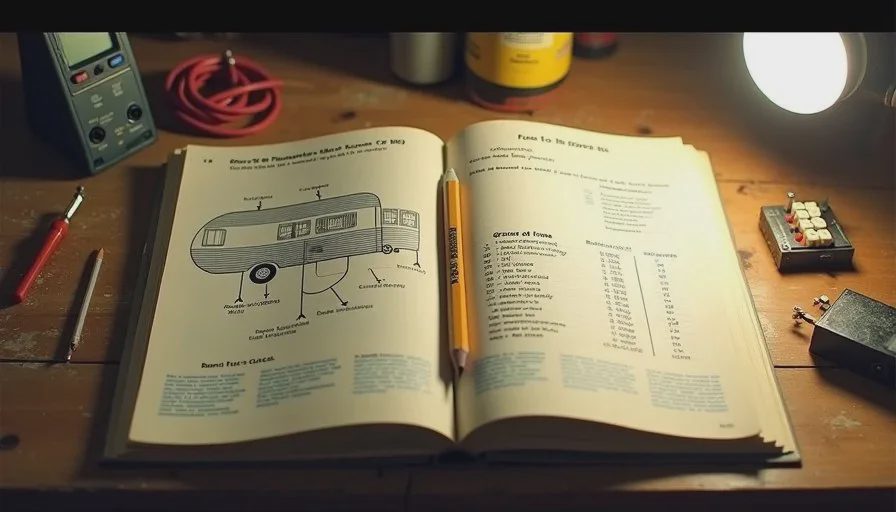
I own a 1974 Shasta camping trailer named The Debugger, and I own a service manual for it that was printed before I was born. Both of them are stubborn. So when people ask how to use AI as a beginner on something genuinely messy, I point at that manual. This post is the third entry in The AI Test Log, and it is the test I get asked about most: can a language model actually read a fifty-year-old document and give me usable answers, or does it just sound confident while making things up?
I ran the test over four evenings in my garage. I had the manual, a work light, a multimeter, and two AI assistants. I did not have a wiring diagram for the trailer's specific floor plan, which turned out to be the whole story.
The Problem: A Manual, a Trailer, and a Dead Circuit
What Was Actually Broken
The Debugger's interior lights had stopped working on the circuit that also feeds the water pump. The trailer has a 12-volt system and a separate 120-volt shore power hookup, and the previous owner had made at least two modifications I could see and probably one I could not. I wanted to trace the fault without pulling every panel off the wall.
Why I Thought AI Might Help
The manual is typewritten, uses terminology that has drifted out of common use, and refers to components by part numbers that mean nothing to a modern search engine. It also assumes the reader already understands 1970s RV electrical conventions. I hoped an assistant could translate the language and point me at the right section without me reading all ninety pages.
That hope was partly reasonable. It was also the source of my biggest mistake, which I will get to.
The Setup: How I Fed the Manual to the AI
What I Actually Uploaded
I photographed twelve pages: the table of contents, the 12-volt system overview, the fuse and breaker page, the lighting section, and the water pump page. I uploaded them as images rather than retyping the text, because retyping would have introduced errors and defeated the purpose of the test.
I also wrote a short brief. 1974 Shasta trailer. 12-volt interior lighting circuit also feeds the water pump. Lights dead, pump dead, shore power works fine. I want the likely fault locations in order of probability and the exact pages you are reading from.
That last sentence is the most important thing I have learned about AI workflow examples on old documents. Ask the model to cite the page it used. It changes the entire quality of the answer.
What I Deliberately Left Out
I did not tell the assistant my guess about the fault. I wanted to see whether it would reach the same conclusion on its own. I also did not upload the modification photos, because I wanted to test the manual-reading part first and add complexity later.
The Tools
Two general-purpose assistants, both with image upload. No specialty tool. No subscription beyond what I already pay for.
The Test: Four Evenings, Three Questions
Question One — What Does This Circuit Actually Include?
I asked the assistant to list every component on the 12-volt lighting circuit according to the pages I uploaded. It came back with a clean list: battery, main fuse, branch fuse, light fixtures, water pump, and a ground point at the frame. It cited the fuse page and the system overview page by name.
That list was correct, and it matched what I found when I traced the wiring by hand. Credit where it is due. The translation from 1974 terminology into plain language was genuinely useful, and it took the assistant about ninety seconds.
Question Two — What Is the Most Likely Fault?
This is where things got interesting. The assistant ranked the likely causes: blown branch fuse, corroded ground connection, failed switch, broken wire at a fixture. It put the branch fuse first.
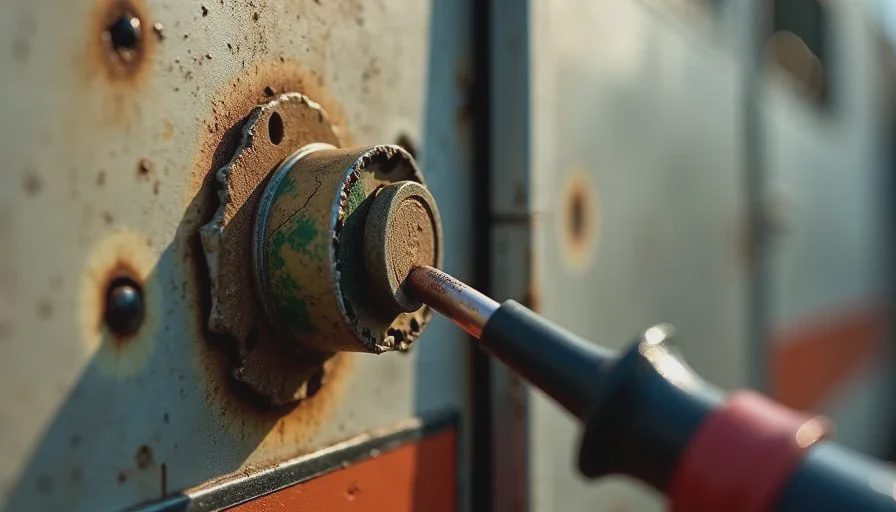
On my trailer, the branch fuse was fine. The corroded ground at the frame was the actual fault. The assistant had ranked it second, which is not a bad ranking, but it led with the fuse because that is the most common failure across all trailers. It was giving me the statistically likely answer, not the answer for my trailer.
That is a subtle and important distinction. A model trained on general repair knowledge will lead with the common case. Your trailer is a specific case.
Question Three — Can You Read This Part Number?
I asked the assistant to identify a component by the part number stamped on the fuse block. It gave me a confident answer with a plausible-sounding specification.
I could not verify that specification anywhere. The number did not appear in the manual's parts list, and the manufacturer has been out of business for decades. When I pushed back and asked where the information came from, the assistant walked it back and admitted it was inferring from similar part numbers.
That is the failure mode you have to watch for. It was not lying. It was filling a gap with something reasonable, and reasonable is not the same as verified. For a 12-volt circuit, a wrong amperage rating is a fire risk. I replaced the fuse block with a modern equivalent rated by a supplier who could actually document it.
What Worked
Terminology Translation
Old manuals use language that assumes a 1970s service technician. The assistant converted phrases like "chassis return" into "ground connection at the frame" without losing the meaning. For anyone new to electrical work, that alone justifies the twenty minutes.
Finding the Right Section
I asked which pages covered the lighting circuit, and the assistant pointed me at the correct three pages out of the twelve I had uploaded. I had already found them, but it was faster than my own skim.
Structured Fault Ordering
Even though the ranking was not right for my trailer, having a ranked list of probable causes gave me a checklist. I worked down it with a multimeter. That structure is worth something, and it is a good example of AI tools that actually save time when the task is organizing rather than deciding.
What Failed
The Invented Specification
I covered this above, and it is the single biggest risk in this entire test. If I had trusted that part number answer, I would have installed an undersized fuse in a circuit that also drives a pump. The lesson is simple and non-negotiable: any number the model cannot cite from a document you gave it should be treated as a guess.
The Manual Was Not the Whole Story
The previous owner's modifications were not in the manual, obviously. The assistant kept answering as if the trailer matched the printed diagram. It never asked whether the wiring had been modified. I had to introduce that fact myself before the answers improved.
Ask the model to state its assumptions. If it does not, supply them.
Confidence Scaling With Detail
The more specific my question got, the more confident the tone became, even when the underlying information got thinner. Long, technical-sounding answers are not evidence of accuracy. This is a pattern I have now seen in enough real-world AI use cases that I treat it as a rule.
What Still Needed Human Judgment
Everything that touched safety. Fuse ratings, wire gauge, and anything involving 120-volt shore power stayed with me and with a licensed electrician for the parts I was unsure about. A model cannot smell burning insulation or see a scorch mark behind a panel.
I also kept the final call on the ground repair. The assistant suggested cleaning the frame contact point. I did that and also replaced the ring terminal, because it was brittle and I could see the corrosion had traveled up the wire. The model gave me the concept. The physical inspection gave me the scope.
Cost and Time
AI cost: nothing beyond existing subscriptions. Time spent photographing pages and writing the brief: about thirty minutes. Time saved on reading and translating the manual: I would estimate two hours. Time lost chasing one wrong part number and re-verifying: about forty minutes. Net, I came out ahead, but not by as much as the demo videos suggest.
Final Verdict
Useful with guardrails.
For translating old technical language, finding the right section, and building a troubleshooting checklist, AI earned its place in my garage. For part numbers, specifications, and anything that carries a safety consequence, it did not. It read the manual about as well as a sharp assistant who has never touched a trailer. That is a real contribution. It is not the same as expertise.
Take it apart first. Then ask AI.


No comments yet — be the first to share a thought.